

Feeling anxious is something everyone experiences at some point—before exams, interviews, or important life decisions. Learning idioms for anxious helps you express these emotions naturally and confidently in English conversations. Instead of repeating simple words like “nervous,” idioms add color, depth, and personality to your speech.
For English learners, students, and professionals, mastering these idioms improves fluency, boosts confidence, and makes communication more engaging. You’ll also better understand movies, books, and native speakers. In real life, these expressions help you describe feelings more accurately in both formal and informal situations.
What Are Idioms for Anxious?
Idioms for anxious are phrases that describe nervousness, worry, or fear using figurative language.
Example Idioms:
- On edge
- Butterflies in your stomach
- A bundle of nerves
Why They Matter:
- Make speech more natural
- Help express emotions vividly
- Improve listening comprehension
Idioms About Being Nervous
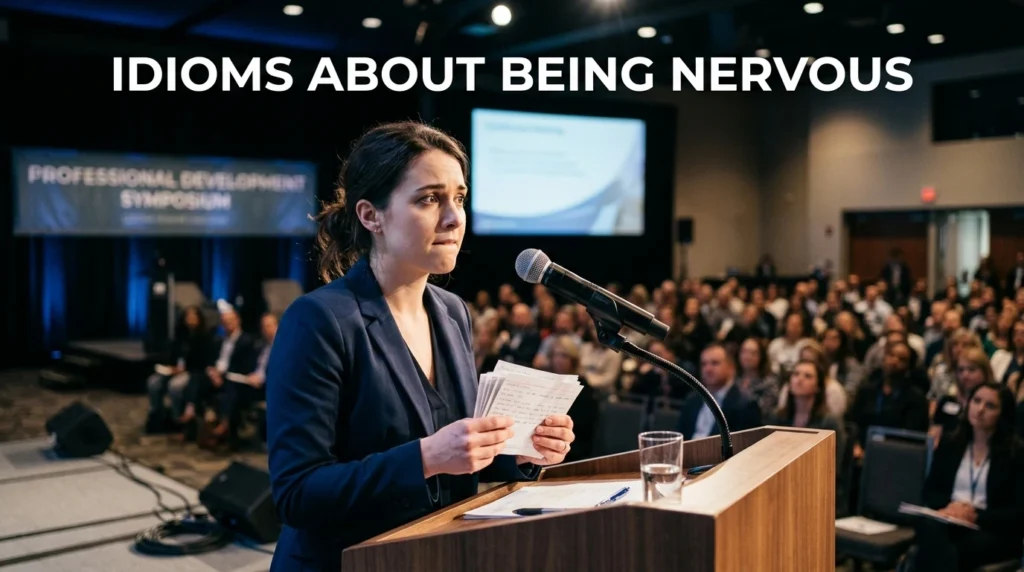
- Have butterflies in your stomach – To feel anxious or excited before an important event.
- Be on pins and needles – To feel extremely nervous while waiting for something.
- Shake like a leaf – To tremble because of fear or nervousness.
- Get cold feet – To become nervous and back out of a planned action.
- Break out in a cold sweat – To suddenly start sweating because of anxiety or fear.
- Be a bundle of nerves – To feel extremely tense and worried.
- Have your heart in your mouth – To feel sudden fear or intense nervousness.
- Jump out of your skin – To react nervously or be easily startled.
- Feel like a deer in the headlights – To become frozen with fear or uncertainty.
- Be on edge – To feel tense, uneasy, and unable to relax.
- Have shaky knees – To feel physically weak because of nervousness.
- Lose your nerve – To suddenly lose confidence or courage.
- Sweat bullets – To feel very anxious or worried about something.
Butterflies in Your Stomach
Meaning: Feeling nervous or excited
Example: I had butterflies in my stomach before my presentation.
Alternative: Feeling jittery
Fun Fact: This idiom comes from the fluttery feeling in your stomach caused by anxiety.
Use Case: Exams, first dates, interviews
On Edge
Meaning: Feeling tense or nervous
Example: She has been on edge all day waiting for the results.
Alternative: Tense, uneasy
Use Case: Waiting situations, stress at work
Idioms for Being Nervous
- Discover common idioms for being nervous that describe anxiety, worry, and uneasiness in everyday English.
- Learn the meaning of each idiom in simple and easy-to-understand language.
- See practical example sentences that show how each idiom is used in real-life conversations.
- Explore idioms that describe pre-exam jitters, job interview nerves, stage fright, and other stressful situations.
- Improve your vocabulary by learning expressions commonly used by native English speakers.
- Understand the difference between idioms that express mild nervousness and those that describe extreme anxiety.
- Use these idioms to make your speaking and writing more natural, expressive, and engaging.
- Discover which nervousness-related idioms are appropriate for casual conversations and professional settings.
- Learn how writers use these idioms to describe a character’s emotions and reactions vividly.
- Avoid common mistakes by understanding the correct context for each idiomatic expression.
- Build confidence in your English by practicing these idioms in daily conversations.
- Find idioms that express physical signs of nervousness, such as trembling, sweating, or feeling tense.
- Enhance your storytelling by using colorful expressions that capture emotional moments.
- Practice using nervousness idioms to communicate your feelings more accurately and effectively.
- Expand your English skills with useful idioms that help describe fear, anticipation, and anxious excitement naturally.
A Bundle of Nerves
Meaning: Extremely anxious
Example: He was a bundle of nerves before going on stage.
Alternative: Very stressed
Use Case: Public speaking, performances
Jump Out of Your Skin

Meaning: To be easily startled
Example: I nearly jumped out of my skin when I heard the loud noise.
Alternative: Get scared suddenly
Use Case: Sudden fear or shock
Have Cold Feet
Meaning: Suddenly become nervous or unsure
Example: She got cold feet before her wedding.
Alternative: Back out
Use Case: Big decisions
Sweat Bullets
Meaning: Be extremely nervous
Example: He was sweating bullets during the interview.
Alternative: Very anxious
Use Case: High-pressure situations
Heart in Your Mouth
Meaning: Extremely anxious or frightened
Example: My heart was in my mouth during the final moments of the match.
Alternative: Terrified
Use Case: Suspenseful situations
Idioms for Overthinking
- Discover common idioms for overthinking that describe excessive worrying, analyzing, and second-guessing.
- Learn the meaning of each idiom in clear and easy-to-understand English.
- Explore expressions that describe mental stress, doubt, and constant overanalysis.
- Understand how native English speakers talk about overthinking in everyday conversations.
- See practical example sentences that show the correct use of each idiom.
- Learn idioms that describe worrying about the future or dwelling on the past.
- Improve your English vocabulary with figurative expressions related to overthinking and anxiety.
- Discover idioms that fit personal, academic, workplace, and social situations.
- Understand the difference between careful thinking and unhealthy overthinking through common expressions.
- Use these idioms to make your writing, storytelling, and conversations more natural and expressive.
- Avoid common mistakes by learning the proper context for each overthinking-related idiom.
- Find idioms that describe hesitation, self-doubt, indecision, and mental exhaustion.
- Build confidence by recognizing when and how to use these expressions appropriately.
- Expand your communication skills with idioms that express complex thoughts in a simple and engaging way.
- Practice these idioms regularly to sound more fluent and communicate your thoughts with greater clarity.
Like a Cat on a Hot Tin Roof
Meaning: Very restless and anxious
Example: She was like a cat on a hot tin roof waiting for the call.
Use Case: Waiting nervously
Lose Sleep Over Something
Meaning: Worry a lot
Example: Don’t lose sleep over small problems.
Use Case: Overthinking
A Nervous Wreck
Meaning: Extremely anxious
Example: He was a nervous wreck before his exam.
Use Case: High anxiety
Bite Your Nails
Meaning: Show nervousness
Example: She bites her nails when she’s anxious.
Fun Fact: This is also a real physical habit linked to anxiety.
Idioms for Panic

- Panic stations – A phrase used when everyone suddenly rushes because of an emergency or unexpected problem.
- Run around like a headless chicken – Describes someone acting in a confused and panicked way without a clear plan.
- Lose your head – Means to become so frightened or stressed that you cannot think clearly.
- Go to pieces – Refers to someone who becomes emotionally overwhelmed and panics.
- Break out in a cold sweat – Describes the physical reaction of intense fear or panic.
- Have your heart in your mouth – Means to feel sudden fear or anxiety, often while waiting for an uncertain outcome.
- Jump out of your skin – Used when someone is startled so badly that they react with panic.
- Be in a flap – Means to be nervous, upset, or panicking over a situation.
- Get into a tizzy – Refers to becoming overly anxious or panicked about something.
- Be beside yourself – Means to be extremely worried, frightened, or overwhelmed with panic.
- Fly off the handle – Describes someone who reacts suddenly and emotionally in a stressful situation.
- Hit the panic button – Means to overreact with fear or panic before fully understanding the situation.
- Freeze up – Refers to becoming unable to move or think because of fear or panic.
In a Panic
Meaning: Very anxious and afraid
Example: He was in a panic before the deadline.
Have a Knot in Your Stomach
Meaning: Feel anxious or uneasy
Example: I had a knot in my stomach before speaking.
Walking on Pins and Needles
Meaning: Extremely nervous or worried
Example: She was on pins and needles waiting for the results.
Grouping Idioms by Context
Academic Anxiety
- Butterflies in your stomach
- A nervous wreck
- Sweat bullets
Work/Professional Anxiety
- On edge
- Lose sleep over
- In a panic
Social Anxiety
- Bite your nails
- Heart in your mouth
- Walking on pins and needles
Tips for Using Idioms Effectively
- Use them in informal conversations
- Avoid overusing in formal writing
- Practice with real-life scenarios
- Learn context before using
Common Mistakes to Avoid
- ❌ Using idioms literally
- ❌ Mixing idioms incorrectly
- ❌ Overusing too many idioms in one sentence
- ❌ Using informal idioms in formal settings
Interactive Exercise (Easy Level)
Fill in the blanks:
- I had ______ in my stomach before the exam.
- He was ______ of nerves during the interview.
- She is on ______ waiting for the results.
Answers:
- Butterflies
- A bundle
- Edge
Interactive Exercise (Medium Level)
Match the idiom with its meaning:
IdiomMeaningSweat bullets?Cold feet?On edge?
Answers:
- Sweat bullets = Very nervous
- Cold feet = Lose courage
- On edge = Tense
Advanced Practice (Quiz)
Choose the correct idiom:
- He was extremely nervous → a) Cold feet b) A bundle of nerves c) On cloud nine
Answer: b
Real-Life Scenarios
Interview Situation
“I was sweating bullets before entering the room.”
Exam Situation
“I had butterflies in my stomach all morning.”
Waiting Situation
“I was on pins and needles waiting for the call.”
Idioms for Scared – SimilesHive
- Scared stiff – So frightened that you feel unable to move or react. 😨
- Shake like a leaf – To tremble uncontrollably because of fear or nervousness. 🍃
- Jump out of your skin – To become suddenly startled or terrified. ⚡
- Have butterflies in your stomach – To feel anxious or scared before an important event. 🦋
- Break out in a cold sweat – To start sweating because of fear or extreme stress. 💦
- Heart in your mouth – To feel intense fear or worry in a frightening situation. ❤️
- Petrified with fear – Completely frozen or overwhelmed by terror. 🪨
- Get cold feet – To lose courage or become too scared to continue. 🦶
- White as a ghost – To become extremely pale because of fear or shock. 👻
- Have your heart skip a beat – To experience a sudden moment of fear or surprise. 💓
- Scare the life out of someone – To frighten someone very badly. 😱
Idioms for Overthinking

- Go round in circles – To keep thinking about the same problem without finding a solution.
- Overanalyze every detail – To examine something too closely and think about it more than necessary.
- Make a mountain out of a molehill – To make a small issue seem much bigger than it really is.
- Get lost in thought – To become deeply absorbed in your thoughts and worries.
- Second-guess yourself – To doubt your own decisions by repeatedly questioning them.
- Put your mind in a spin – To feel mentally overwhelmed by too many thoughts.
- Rack your brain – To think very hard while trying to solve or understand something.
- Toss and turn – To worry or think so much that you cannot relax or sleep.
- Have a lot on your mind – To be thinking about many concerns or responsibilities.
- Think yourself into a corner – To overthink until you feel stuck and unable to decide.
- Beat yourself up – To repeatedly blame or criticize yourself in your thoughts.
- Dwell on something – To keep thinking about something for too long.
- Read too much into something – To find meanings or problems that may not actually exist.
Suggestions for Visuals or Infographics
- Emotion chart showing anxiety levels
- Idiom usage timeline
- Comparison of formal vs informal expressions
- Illustrations of idioms (e.g., butterflies, pins and needles)
Idioms for Scared SimilesHive
- Shake like a leaf – To tremble because of fear.
- Have butterflies in your stomach – To feel nervous or frightened before something happens.
- Jump out of your skin – To become extremely startled or scared.
- Scared stiff – So frightened that you cannot move.
- Frozen with fear – Unable to react because of intense fear.
- Heart in your mouth – Feeling extremely anxious or frightened.
- Break out in a cold sweat – To suddenly sweat because of fear or anxiety.
- Get cold feet – To become too scared to continue with a plan.
- White as a ghost – Looking very pale because of fear.
- Hair stood on end – Feeling intense fear or horror.
- Weak at the knees – Feeling shaky due to fear or nervousness.
- Petrified with fear – Completely terrified and unable to think clearly.
Pro Tips for Mastery
- Practice daily with sentences
- Watch English movies and note idioms
- Use flashcards
- Speak with friends using idioms
Why Learning Idioms for Anxious Is Important
- Improves emotional expression
- Makes you sound fluent
- Helps in exams like IELTS
- Enhances writing skills
Nervous Idioms

- Butterflies in my stomach – Feeling anxious, worried, or excited before an important moment. 🦋
- Have cold feet – To suddenly feel nervous or unsure about doing something. ❄️
- On pins and needles – Feeling very nervous while waiting for something to happen. 📌
- A bundle of nerves – Someone who feels extremely anxious or stressed. 😰
- Bite my nails – To show nervousness or worry through a nervous habit. 💅
- Heart in my mouth – Feeling sudden fear, shock, or nervous excitement. ❤️
- Sweating bullets – Feeling extremely nervous or scared. 💦
- Jump out of my skin – Feeling startled, shocked, or suddenly nervous. 😱
- Lose my nerve – To become too nervous to do something you planned. 😟
- Shaking like a leaf – Trembling because of fear, stress, or nervousness. 🍃
- Walking on eggshells – Being very careful because you feel nervous about causing a problem. 🥚
- Break into a cold sweat – To suddenly feel nervous, frightened, or anxious. 🥶
- Feel the jitters – To experience nervous feelings before an event or situation. ⚡
- A nervous wreck – A person who feels overwhelmed by anxiety or stress. 🚧
Key Takeaways
Idioms for anxious are powerful tools that make your English expressive and natural. From “butterflies in your stomach” to “on edge,” each phrase adds depth to your communication. By learning meanings, practicing regularly, and using them in real-life situations, you can significantly improve your fluency and confidence.
Start small, practice daily, and soon these idioms will become a natural part of your vocabulary!
Idioms for Panicking
- Learn common idioms for panicking that describe fear, anxiety, and sudden moments of confusion.
- Discover expressions that native English speakers use when someone becomes overwhelmed or loses composure.
- Understand the meaning of each panic-related idiom through simple explanations and real-life examples.
- Explore idioms that describe reactions to unexpected problems, emergencies, and stressful situations.
- Improve your English vocabulary with colorful expressions related to panic and nervousness.
- Learn the difference between mild worry, anxiety, and full panic through idiomatic language.
- Use these idioms to make your conversations, stories, and essays more expressive and realistic.
- Find idioms that are suitable for casual conversations, creative writing, and classroom activities.
- Understand when each idiom is appropriate and avoid using it in the wrong context.
- See how idioms for panicking can add emotion and vivid imagery to your writing.
- Practice using panic-related idioms to sound more natural and fluent in English.
- Explore both humorous and serious idioms that describe feeling frightened or overwhelmed.
- Learn expressions that describe losing control, becoming flustered, or reacting under pressure.
FAQs :
1. What are idioms for panicking?
Idioms for panicking are common English expressions that describe feelings of fear, anxiety, nervousness, or losing control in stressful situations. They make conversations more natural and expressive.
2. Why should I learn idioms for panicking?
Learning idioms for panicking improves your English vocabulary, helps you understand native speakers, and allows you to describe stressful situations in a more vivid and engaging way.
3. Can I use panicking idioms in everyday conversations?
Yes. Many panicking idioms are commonly used in daily conversations, movies, books, and social media. However, some are informal, so it’s important to use them in the right context.
4. What is the difference between an idiom and a literal expression?
A literal expression means exactly what the words say, while an idiom has a figurative meaning that cannot be understood by translating each word individually.
5. Are idioms for panicking suitable for formal writing?
Most panicking idioms are best suited for informal conversations, storytelling, and creative writing. In formal or academic writing, it’s usually better to use clear and direct language instead.
6. How can I remember idioms for panicking more easily?
Practice using them in sentences, read English books and articles, watch movies or TV shows, and use the idioms in everyday conversations to reinforce your learning.
7. What are some common situations where panicking idioms are used?
They are often used to describe exam stress, job interviews, public speaking, emergencies, unexpected news, deadlines, and other high-pressure situations.
Conclusion :
Learning idioms for panicking is a great way to make your English more natural, expressive, and engaging. These colorful expressions help you describe fear, anxiety, stress, and nervous reactions in ways that sound more like everyday English.
If you’re preparing for exams, improving your communication skills, or expanding your vocabulary, these idioms can make your conversations and writing more interesting.
The key to mastering these expressions is regular practice. Try using them in daily conversations, writing exercises, or while reading English content. Over time, you’ll become more confident in recognizing and using idioms for panicking, helping you communicate emotions clearly and understand native English speakers with ease.