
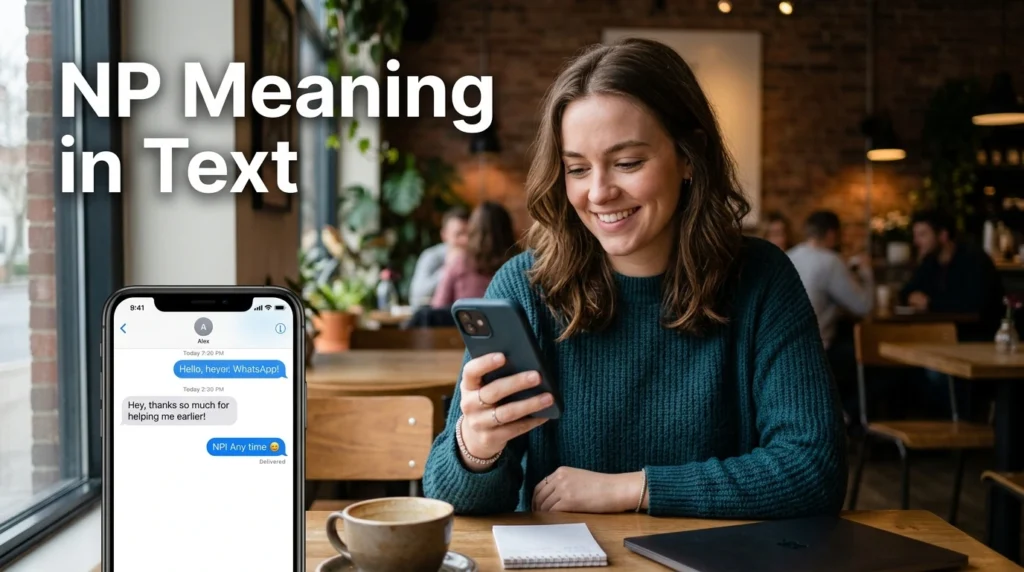
Have you ever received a message that simply says “NP” and wondered what it means? You’re not alone. Every day, people search for np meaning in text because internet slang changes quickly, and short abbreviations can be confusing if you are unfamiliar with them.
If you are chatting with friends, texting classmates, or scrolling through TikTok comments, you’ll often come across these tiny shortcuts.
Understanding online slang helps you communicate naturally and avoid misunderstandings. It also makes conversations on social media feel easier and more enjoyable.
In this guide, you’ll learn the complete np meaning in text, its full form, where it came from, how people use it on different platforms, and how to respond confidently. By the end, you’ll know exactly when and how to use NP in everyday digital conversations.
What Does NP Mean in Text?
The most common NP meaning in text is No Problem.
People use it as a quick, friendly reply after someone thanks them or apologizes. It lets the other person know that everything is okay and there is nothing to worry about.
Short Meaning
NP = No Problem
It simply means:
- You’re welcome.
- It’s okay.
- Don’t worry about it.
- Happy to help.
- It wasn’t a big deal.
The abbreviation is popular because it saves time while typing and keeps conversations casual.
Example
Alex: Thanks for helping me with my homework.
Sam: NP!
In this example, NP means “No Problem.”
NP Full Form in Texting
The full form of NP is:
No Problem
It is one of the oldest and most widely recognized texting abbreviations.
Instead of typing:
- No problem
- You’re welcome
- It’s fine
- Anytime
People simply type:
NP
The meaning remains friendly and polite.
The Origin of NP in Online Chat
The abbreviation NP became popular during the early days of internet messaging.
It first appeared in:
- Internet chat rooms
- Online gaming
- IRC chats
- Instant messaging services
- Early texting
Back when people had limited characters and slower keyboards, abbreviations made conversations much faster.
As texting evolved, NP remained popular because it is easy to remember and universally understood.
Today, millions of people still use it daily.
Why Is NP So Popular?
There are several reasons why NP continues to be common.
It is fast
Typing two letters takes only a second.
It sounds friendly
Unlike formal replies, NP feels relaxed.
Everyone understands it
Most internet users recognize its meaning immediately.
It fits every platform
Whether you’re texting or commenting online, NP works naturally.
It avoids awkwardness
Instead of making a long reply after someone thanks you, NP keeps things simple.
How Is NP Used in Real Conversations?
People mainly use NP after:
- Someone says thank you.
- Someone apologizes.
- Someone asks for help.
- Someone appreciates your effort.
Example 1
Friend: Thanks for waiting.
You: NP!
Example 2
Friend: Sorry I’m late.
You: NP. We just started.
Example 3
Friend: Thanks for sharing your notes.
You: NP! Glad they helped.
Example 4
Coworker: Thanks for covering my shift.
You: NP. Anytime.
Example 5
Sibling: Sorry for borrowing your charger.
You: NP.
NP Meaning on WhatsApp
WhatsApp conversations are usually casual, making NP extremely common.
People use it to reply quickly.
Examples include:
Friend: Thanks for sending the photos.
You: NP 😊
Mom: Thanks for picking up groceries.
You: NP!
Classmate: Thanks for explaining the assignment.
You: NP. Good luck!
WhatsApp users often pair NP with emojis to sound warmer.
Examples:
- NP 😊
- NP 👍
- NP ❤️
- NP 😄
NP Meaning on Instagram
On Instagram, NP often appears in:
- Direct Messages
- Story replies
- Comments
- Group chats
Example:
Follower: Thanks for answering my question.
Creator: NP!
Another example:
Friend: Thanks for tagging me.
You: NP 😊
Instagram users usually keep replies short, making NP a natural choice.
NP Meaning on TikTok
TikTok comments move quickly, so short abbreviations are everywhere.
Users reply with NP when:
- Someone thanks them.
- They answer a question.
- They share a video link.
Example:
User: Thanks for explaining this trend.
Creator: NP ❤️
Another example:
Comment: Thanks for the tutorial.
Reply: NP! Glad it helped.
NP Meaning on Snapchat
Snapchat conversations are usually informal.
Because messages disappear quickly, people often use abbreviations.
Example:
Friend: Thanks for the Snap.
You: NP 😄
Another example:
Friend: Sorry I replied late.
You: NP!
Snapchat users often combine NP with emojis or stickers.
Different Ways People Use NP
Although No Problem is the primary meaning, it can express slightly different ideas depending on context.
You’re Welcome
Thanks!
NP!
Don’t Worry
Sorry I’m late.
NP.
Happy to Help
Thanks for your advice.
NP! Anytime.
It Was Easy
Thanks for fixing it.
NP.
No Big Deal
Sorry for bothering you.
NP.
What Does NP Sound Like in Tone?
Tone depends on the conversation.
It can sound:
- Friendly
- Relaxed
- Casual
- Helpful
- Reassuring
- Polite
Adding emojis can make it feel even warmer.
Examples:
- NP 😊
- NP 👍
- NP 😄
- NP ❤️
What NP Does NOT Mean
Although No Problem is the most common meaning, NP can have different meanings in other situations.
For example:
- Nurse Practitioner (medical field)
- New Player (gaming)
- Network Protocol (technology)
- Number of Pages (publishing)
- Not Provided (forms)
However, in texting and social media conversations, NP almost always means No Problem.
Always consider the context before assuming another meaning.
Common Misunderstandings About NP
Some people confuse NP with other abbreviations.
Here are a few examples.
NP vs NP (Medical)
Doctors often use NP for Nurse Practitioner.
That meaning is unrelated to texting.
NP vs Nope
Some beginners think NP means “Nope.”
That is incorrect.
“Nope” means “No.”
“NP” means “No Problem.”
NP vs NVM
NVM means Never Mind.
NP means No Problem.
They have completely different meanings.
NP vs TY
TY means Thank You.
NP is usually the reply to TY.
Example:
TY!
NP!
Similar Slang Terms to NP
Many abbreviations have similar meanings.
YW
You’re Welcome.
NP
No Problem.
OFC
Of Course.
IDC
I Don’t Care.
(Context is different.)
DW
Don’t Worry.
KK
Okay.
TY
Thank You.
THX
Thanks.
TYW
Thank You, You’re Welcome.
Anytime
Not an abbreviation, but often used instead of NP.
Alternatives to Saying NP
If you don’t want to use NP every time, you can say:
- You’re welcome.
- Anytime.
- Happy to help.
- Glad to help.
- Don’t mention it.
- Of course.
- Sure thing.
- My pleasure.
- It was nothing.
- Always happy to help.
These alternatives fit both casual and professional conversations.
How to Reply When Someone Says NP
Sometimes another person replies with NP after you thank them.
Here are different ways you can continue the conversation.
Polite Replies
- Thank you again!
- I appreciate it.
- You’re very kind.
- Thanks so much.
- Have a great day!
Friendly Replies
- You’re awesome!
- You’re the best.
- Thanks!
- Appreciate you.
- See you later!
Flirty Replies
Use these only if the relationship is playful.
- You’re always so sweet.
- I owe you one.
- You’re my favorite helper.
- Guess I’ll have to thank you in person.
- That’s why you’re amazing.
Respectful Replies After NP
If someone says NP after helping you:
- Thanks again.
- I’ll remember that.
- Really appreciate it.
- That helped a lot.
- You’re very thoughtful.
How to Use NP Naturally
Using NP is easy.
Simply remember these situations:
Use NP when:
- Someone thanks you.
- Someone apologizes.
- Someone worries about bothering you.
- Someone appreciates your help.
Avoid using NP in:
- Formal business emails.
- Academic reports.
- Official documents.
- Serious legal communication.
Instead, use complete phrases like:
- You’re welcome.
- It was my pleasure.
- Happy to help.
Is NP Still Popular?
Yes.
Even though Gen Z creates new slang every year, NP remains one of the most common abbreviations online.
Its popularity continues because it is:
- Easy to type.
- Friendly.
- Universal.
- Understood by almost everyone.
- Useful in daily conversations.
Unlike trend-based slang that disappears quickly, NP has stayed relevant for decades.
NP in Gen Z Slang Culture
Gen Z often mixes old abbreviations with newer internet expressions.
While newer slang such as “FR,” “NGL,” “IMO,” and “IDK” appears frequently, NP remains part of everyday texting because it solves a simple communication need.
Instead of sounding outdated, it feels familiar and efficient.
Many younger users even combine it with emojis or GIFs to sound more expressive.
Examples:
- NP 😂
- NP ❤️
- NP 😊
- NP 👍
Tips for Using NP Correctly
Keep these tips in mind.
- Use NP after someone thanks you.
- Use it in casual conversations.
- Don’t overuse abbreviations in formal writing.
- Read the conversation context first.
- Add emojis if you want a warmer tone.
- Remember that context determines meaning.
Following these simple tips helps you sound natural online.
Examples of NP in Everyday Chats
Friends
Friend: Thanks for lending me your headphones.
You: NP!
Family
Brother: Thanks for waiting.
You: NP 😊
School
Classmate: Thanks for sharing today’s notes.
You: NP!
Gaming
Teammate: Thanks for the revive!
You: NP 😄
Social Media
Follower: Thanks for answering my question.
Creator: NP ❤️
When Should You Avoid Using NP?
Although NP is friendly, there are situations where writing the full phrase is better.
Avoid NP when:
- Writing job applications.
- Sending professional emails.
- Talking to clients.
- Writing school assignments.
- Communicating with people who may not understand internet slang.
In these situations, writing “You’re welcome” or “No problem” in full appears more professional.
NP Meaning in Gaming Chats
Gaming communities were among the first places where NP became a popular abbreviation. Players often use it after someone thanks them for help, revives them during a match, shares resources, or apologizes for making a mistake. Since games move quickly, typing “NP” is much faster than writing “No Problem.”
In multiplayer games, teamwork is important, and NP helps keep the atmosphere friendly. Whether you’re playing a competitive shooter, an MMORPG, or a casual mobile game, you’ll likely see players using NP to show good sportsmanship.
Common Gaming Examples
- Player 1: Thanks for the backup!
- Player 2: NP!
- Player 1: Sorry I missed that shot.
- Player 2: NP, we’ll get the next round.
- Player 1: Thanks for the extra health pack.
- Player 2: NP!
Using NP in games creates a positive environment and encourages teamwork.
NP vs Other Popular Texting Abbreviations
Many texting abbreviations look similar, making them easy to confuse. Understanding the differences helps you avoid misunderstandings during online conversations.
| Abbreviation | Full Form | Meaning |
|---|---|---|
| NP | No Problem | You’re welcome or don’t worry. |
| TY | Thank You | Used to express gratitude. |
| YW | You’re Welcome | A direct response to thanks. |
| NVM | Never Mind | Forget what I said. |
| DW | Don’t Worry | Reassures someone not to stress. |
| OFC | Of Course | Indicates willingness or agreement. |
| BRB | Be Right Back | Leaving temporarily. |
| IMO | In My Opinion | Sharing a personal view. |
Although these abbreviations are common, NP remains one of the easiest and friendliest ways to respond to appreciation.
Should You Use NP in Professional Conversations?
While NP works perfectly in casual texting, it isn’t always the best choice in professional communication. Business emails, workplace chats with clients, and formal messages usually benefit from complete sentences instead of abbreviations.
For example, instead of replying with “NP,” you can write:
- You’re welcome.
- Happy to help.
- My pleasure.
- Glad I could assist.
- It was no trouble at all.
However, in relaxed workplace chats among coworkers who regularly use internet slang, NP may still be acceptable if the company culture is informal.
Choosing the right response depends on your audience and the situation.
Common Mistakes People Make When Using NP
Although NP is simple, beginners sometimes use it incorrectly. Avoiding these mistakes will help your messages sound more natural.
Using NP Before Someone Thanks You
NP is usually a response, not the first message.
Incorrect:
- NP, here’s the document.
Better:
- Here’s the document!
Later:
- Thanks!
- NP!
Using NP in Serious Situations
If someone shares bad news or discusses something emotional, NP may sound too casual. A thoughtful response is often better.
Assuming Every NP Means No Problem
Always consider the conversation. In medicine, education, or technology, NP can stand for something entirely different.
Overusing Abbreviations
Using too many abbreviations in one message can make your writing difficult to understand, especially for people who are unfamiliar with internet slang.
Why People Prefer Saying NP Instead of You’re Welcome
Many people choose NP because it feels more relaxed and conversational. Some even believe it sounds warmer than the traditional phrase “You’re welcome.”
Reasons people prefer NP include:
- It feels casual and friendly.
- It is quicker to type.
- It keeps conversations moving.
- It makes helping someone seem effortless.
- It reduces awkwardness after receiving thanks.
- It fits modern texting culture.
- It works across nearly every messaging app.
- It is recognized by users of all ages.
This simplicity is one reason NP has remained popular for so many years.
Can NP Be Used with Emojis?
Absolutely! Adding emojis can make NP feel more expressive and friendly. Emojis help show your tone, especially since text messages don’t include facial expressions or voice.
Popular combinations include:
- NP 😊
- NP 😄
- NP 👍
- NP ❤️
- NP 🙌
- NP 🤝
- NP 😎
- NP 🌟
Each emoji adds a slightly different feeling. A smiling face feels warm, while a thumbs-up shows confidence and agreement.
Using emojis alongside NP is especially common on WhatsApp, Instagram, Snapchat, and TikTok.
How Parents and Beginners Can Understand NP Easily
If you’re new to texting or helping someone learn internet slang, NP is one of the easiest abbreviations to remember.
A simple way to think about it is:
- Someone says Thank you.
- You reply No Problem.
- Instead of typing the full phrase, you simply write NP.
Remember this easy pattern:
Thank you → NP
That’s all there is to it.
Once you understand this basic exchange, you’ll recognize NP almost everywhere online.
Will NP Continue to Be Popular in the Future?
Internet slang changes quickly, but some abbreviations become timeless. NP belongs to that group because it expresses a universal idea in just two letters.
Even as new slang terms appear every year, NP is likely to remain popular because it is:
- Short and easy to type.
- Friendly across different cultures.
- Understood by people of all ages.
- Useful in both texting and gaming.
- Common on social media.
- Easy for beginners to learn.
- Suitable for almost every casual conversation.
FAQs :
What does NP mean in text?
NP means No Problem. It is a friendly response to thanks or apologies and is commonly used in texting and online chats.
What is the full form of NP?
The full form of NP is No Problem.
What does NP mean on TikTok?
On TikTok, NP usually means No Problem when replying to comments, messages, or thanks.
What does NP mean on Snapchat?
On Snapchat, NP also means No Problem. Friends often use it as a quick and casual response.
Is NP rude?
No. NP is generally considered polite, friendly, and relaxed. However, in very formal conversations, writing the full phrase “No problem” or “You’re welcome” is more appropriate.
Is NP the same as You’re Welcome?
They are very similar. Both respond to thanks, although NP sounds more casual and conversational.
Can NP have other meanings?
Yes. In fields like medicine, technology, publishing, and gaming, NP can have different meanings. In texting, however, it almost always means No Problem.
Should I use NP in professional emails?
It is better to avoid abbreviations in formal emails. Instead, write You’re welcome, My pleasure, or Happy to help.
Conclusion :
Understanding np meaning in text makes online conversations much easier. In most chats, NP simply stands for No Problem, a friendly way to say You’re welcome, Don’t worry, or Happy to help. It has been part of internet culture for many years and continues to be widely used on WhatsApp, Instagram, TikTok, Snapchat, gaming platforms, and text messages.
While NP can have different meanings in professional fields like medicine or technology, context usually makes its intended meaning clear.
By learning when to use NP, when to avoid it, and how to respond naturally, you can communicate with greater confidence and keep your digital conversations friendly, clear, and effortless.