
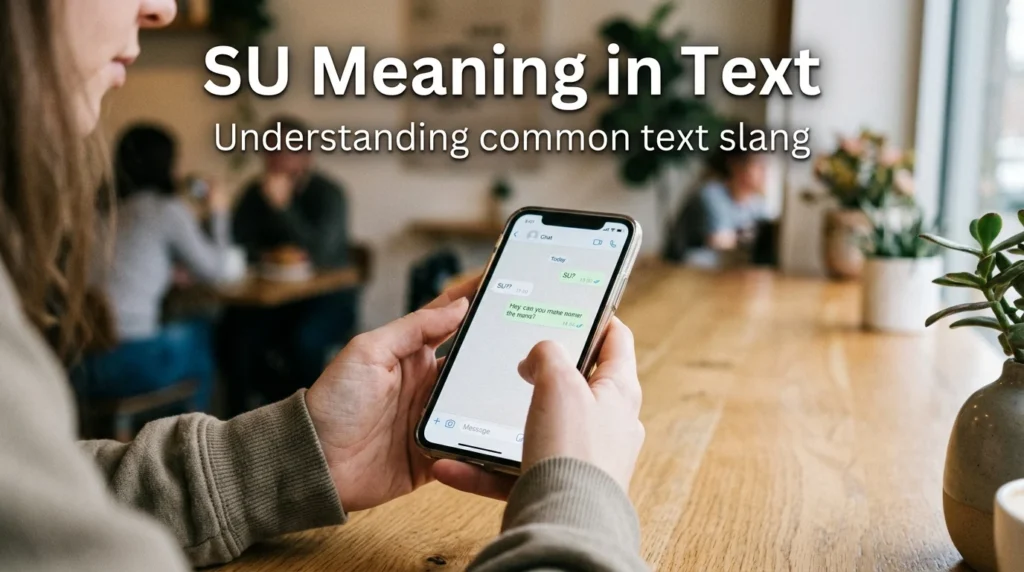
Have you ever received a message with “SU” and wondered what it meant? You’re not alone. Internet slang changes quickly, and new abbreviations appear every day across texting apps and social media platforms. That is why many people search for SU meaning in text to avoid confusion and reply correctly.
The meaning of SU depends on the conversation, but in most texting situations, it commonly means “Swipe Up” or “Shut Up.” In some casual chats, it can also stand for “What’s up?” or other context-based meanings. Understanding the context is the key to interpreting it correctly. Whether you’re chatting on WhatsApp, scrolling through TikTok, or messaging friends on Snapchat, knowing popular internet abbreviations helps you communicate naturally and avoid misunderstandings.
This guide explains everything you need to know about SU meaning in text, including its slang definitions, examples, platform-specific uses, and how to respond confidently.
What Does SU Mean in Text?
The SU meaning in text changes depending on where and how it is used.
The most common meanings include:
- Swipe Up – Used on Instagram Stories to encourage users to open a link.
- Shut Up – Usually playful between friends but can sound rude depending on tone.
- What’s Up? – Sometimes used as a quick greeting in casual conversations.
- See You – Less common but occasionally used when ending a conversation.
Unlike some abbreviations that have only one meaning, SU relies heavily on context.
For example:
Example 1
Friend: SU for today’s event! Meaning: Swipe Up for more information.
Example 2
Friend: SU 😂 You’re joking! Meaning: Shut Up (playfully expressing surprise).
Example 3
Friend: SU? Meaning: What’s up?
Always read the surrounding conversation before deciding which meaning fits.
SU Full Form in Texting
There is no single official full form of SU in texting because internet slang evolves naturally.
Here are the most recognized expansions:
| SU Full Form | Common Usage |
|---|---|
| Swipe Up | Instagram Stories |
| Shut Up | Friendly conversations |
| What’s Up | Casual greeting |
| See You | Saying goodbye |
The intended meaning depends entirely on the conversation.
The Most Popular Slang Meaning of SU
Today, the two most popular slang meanings are:
Swipe Up
This meaning became popular through Instagram Stories when creators asked followers to open links.
Example:
New vlog is live. SU to watch!
Meaning:
Swipe Up to view the content.
Shut Up
Among close friends, SU often means Shut Up, but not necessarily in a rude way.
Example:
Emily: I met my favorite singer today.
Sarah: SU!! No way! 😭
Here, SU simply expresses excitement and disbelief.
The Origin of SU in Internet Slang
Like many internet abbreviations, SU developed because people wanted faster communication.
Several factors helped it become popular:
- Shorter messages save typing time.
- Social media encourages quick replies.
- Teen slang constantly creates new abbreviations.
- Messaging apps favor informal language.
The meaning Swipe Up grew with Instagram Stories.
The meaning Shut Up became common in texting because friends often shorten familiar expressions.
As internet culture evolved, multiple meanings naturally formed.
Why SU Became So Popular
Several reasons explain its popularity.
It Saves Time
Instead of typing entire phrases, users send only two letters.
It Fits Fast Conversations
Modern messaging moves quickly.
Short abbreviations keep chats flowing.
It Works Across Platforms
SU appears on:
- Snapchat
- TikTok
- Discord
- Messenger
Younger Users Prefer Shortcuts
Gen Z and many Millennials regularly use abbreviations like:
- LOL
- BRB
- TBH
- IMO
- SU
How SU Is Used in Real Conversations
Understanding real conversations makes the slang much easier.
Example 1
Alex:
SU 😂
Chris:
I know, right?
Meaning:
Shut up—that’s unbelievable!
Example 2
Influencer:
SU for today’s giveaway!
Meaning:
Swipe Up.
Example 3
Friend:
SU?
You:
Not much. Just relaxing.
Meaning:
What’s up?
Example 4
Friend:
I’ll SU later.
Meaning:
See you later.
Similar Slang Terms and Related Abbreviations
Many abbreviations serve similar purposes.
Here are some common ones.
| Abbreviation | Meaning |
|---|---|
| WYD | What are you doing? |
| WSP | What’s up? |
| SUP | What’s up? |
| BRB | Be right back |
| TBH | To be honest |
| IMO | In my opinion |
| IDK | I don’t know |
| SMH | Shaking my head |
| FR | For real |
| NGL | Not gonna lie |
Learning these together makes online conversations much easier.
SU Meaning on WhatsApp
WhatsApp conversations are usually casual.
There, SU often means:
- Shut Up
- What’s Up
- See You
Example:
Jake:
SU? Haven’t talked in forever.
Meaning:
What’s up?
Another example:
Emma:
SU 😂 You seriously won?
Meaning:
Shut up! That’s amazing!
SU Meaning on Instagram
Instagram has a unique history with SU.
Originally, creators posted:
SU for today’s sale.
Meaning:
Swipe Up.
Although Instagram now uses link stickers instead of swipe-up links, many people still say SU because the phrase became part of social media culture.
Example:
SU to read the full article.
SU Meaning on TikTok
On TikTok, SU usually appears in captions or comments.
Examples include:
- SU for Part 2.
- SU if you agree.
- SU 😂
Depending on the video, it may mean:
- Swipe Up (less common today)
- Shut Up (expressing surprise)
Example:
“This ending… SU 😭”
Meaning:
No way! That’s unbelievable!
SU Meaning on Snapchat
Snapchat users often communicate with extremely short messages.
Common meanings include:
- What’s Up
- Shut Up
Example:
Friend:
SU?
Reply:
Just got home.
Example:
Friend:
You won free concert tickets?
You:
Yep!
Friend:
SU 😂😂
Meaning:
Shut up! That’s awesome!
Other Meanings of SU That Are Not Slang
Outside texting, SU has many unrelated meanings.
Examples include:
- State University
- System Update
- Software Update
- Start Up
- Service Unit
- Storage Unit
- Standard Unit
These meanings are usually found in education, business, or technology.
For example:
“My SU sent an email.”
Here, SU probably means State University, not internet slang.
Always consider the topic before assuming the meaning.
Common Confusions About SU Meaning in Text
Many people misunderstand SU because it has multiple definitions.
Here are common mistakes.
Assuming It Always Means Shut Up
Not every message uses this meaning.
Sometimes it simply means Swipe Up.
Thinking It Is Always Rude
Friends often say SU jokingly.
Tone matters.
Compare:
SU 😂
vs.
SU.
The emoji completely changes how the message feels.
Ignoring the Platform
Instagram often suggests Swipe Up.
WhatsApp usually means Shut Up or What’s Up.
The platform offers important clues.
What SU Does Not Mean
Many people confuse SU with unrelated abbreviations.
It usually does not mean:
- Shut Down
- Sign Up
- Speed Up
- Start Using
- Stay Updated
Unless the conversation clearly indicates those meanings.
Avoid guessing based only on the letters.
How to Reply When Someone Says SU
Your reply depends on which meaning is intended.
If SU Means “What’s Up?”
Replies:
- Just relaxing.
- Nothing much. You?
- Busy with homework.
- Watching Netflix.
- Getting ready for work.
If SU Means “Shut Up”
Friendly replies:
- 😂 You’re funny.
- I know, right?
- Believe it!
- It’s actually true.
- I couldn’t believe it either.
If SU Means “Swipe Up”
Replies:
- Done!
- Just checked it out.
- Nice post.
- Great video.
- Thanks for sharing.
Flirty Replies to SU
If someone jokingly says SU, you can answer playfully.
Examples:
- Only if you stop making me blush. 😊
- You’re cute when you’re shocked.
- Guess I keep surprising you.
- Wait until you hear the rest.
- That’s just the beginning.
Use these only with someone you already know well and who is comfortable with playful teasing.
Polite Replies to SU
When you’re unsure about the tone, keep your response friendly.
Examples:
- Haha, it’s true.
- Thanks!
- I appreciate that.
- Glad you liked it.
- Hope it made your day.
Polite replies work well in almost every situation.
Boundary-Respecting Responses
Sometimes SU may sound rude.
If it makes you uncomfortable, respond respectfully.
Examples:
- Let’s keep things respectful.
- I’d rather not joke like that.
- Can we talk politely?
- I didn’t mean anything bad.
- Let’s continue the conversation respectfully.
Healthy communication always comes first.
Is SU Still Popular?
Yes, SU is still used, but its popularity has changed.
The Swipe Up meaning became less common after Instagram introduced Link Stickers instead of the classic swipe-up feature.
However, many creators still say SU because people recognize the phrase.
The Shut Up meaning remains common among younger users in text messages.
Meanwhile, What’s Up is still used occasionally, although many people now prefer WSP, SUP, or simply Hey.
Overall, SU continues to appear in online conversations, but context is more important than ever.
SU in Gen Z Slang Culture
Gen Z enjoys creating quick, flexible abbreviations.
SU fits perfectly because it is:
- Short.
- Easy to type.
- Informal.
- Adaptable.
- Recognized across multiple platforms.
Like many slang terms, its meaning depends on the conversation instead of a strict dictionary definition.
This flexibility is one reason internet slang changes so quickly.
Tips for Understanding SU Correctly
If you’re unsure what SU means, follow these tips.
- Read the entire conversation.
- Notice emojis.
- Consider the platform.
- Think about who sent the message.
- Ask politely if you’re unsure.
Context almost always reveals the correct meaning.
How to Know Which SU Meaning Someone Is Using
Since SU has multiple meanings, the easiest way to understand it is by looking at the conversation around it. Think about who sent the message, where you received it, and what you were talking about before the abbreviation appeared. Context almost always reveals the correct meaning.
For example, if an Instagram creator writes “SU for today’s giveaway,” they almost certainly mean Swipe Up. If your best friend replies “SU 😂” after hearing exciting news, they probably mean Shut Up in a playful way. If someone simply messages “SU?”, they are likely asking What’s Up?
To avoid misunderstandings:
- Read the entire conversation.
- Notice emojis and punctuation.
- Consider the social media platform.
- Think about your relationship with the sender.
- Ask politely if you’re unsure.
Is SU Formal or Informal?
The SU meaning in text belongs to informal internet language. It is mainly used among friends, classmates, family members, and social media users. It is generally not appropriate for professional communication.
Avoid using SU in:
- Job applications.
- Business emails.
- School assignments.
- Formal customer support messages.
- Professional LinkedIn conversations.
Instead, write the complete phrase when communicating formally.
For example:
Informal:
- SU? Long time no see!
Formal:
- Hello! How have you been?
Choosing the right style helps you make a positive impression.
When You Should Avoid Using SU
Although SU is common online, there are situations where using it can cause confusion or sound impolite. Because it has several meanings, not everyone will understand your intention.
It is best to avoid SU when:
- Talking to teachers or professors.
- Messaging your employer.
- Communicating with clients.
- Speaking with people unfamiliar with internet slang.
- Discussing serious or sensitive topics.
Using complete words makes your message clearer and reduces the chance of misunderstandings.
Examples of SU Meaning in Everyday Text Messages
Real-life examples make it easier to understand how SU appears in online conversations.
Example 1
Ava: I passed my driving test!
Lily: SU 😂 That’s amazing!
Meaning: Shut Up! I can’t believe it.
Example 2
Jake: SU?
Ryan: Just watching a movie.
Meaning: What’s Up?
Example 3
Influencer: New collection is live. SU to shop now!
Meaning: Swipe Up.
Example 4
Emma: I’ll SU tomorrow after class.
Meaning: See You.
These examples show why context is essential when interpreting internet slang.
Why Teenagers and Gen Z Use SU So Often
Teenagers and Gen Z are known for creating and spreading new internet slang. Short abbreviations like SU help them communicate quickly while keeping conversations fun and casual.
Reasons why young people use SU include:
- Faster typing.
- Keeping chats short.
- Following social media trends.
- Expressing emotions quickly.
- Feeling connected to online communities.
Many viral slang words start with younger users before becoming popular with a wider audience.
SU vs SUP vs WSP: What’s the Difference?
These abbreviations look similar but have different meanings.
SU
May mean:
- Swipe Up
- Shut Up
- What’s Up
- See You
SUP
Usually means:
- What’s up?
Example:
- SUP? How’s your day going?
WSP
Almost always means:
- What’s up?
Example:
- WSP tonight?
While SUP and WSP usually have one meaning, SU is more flexible and depends on context.
Can SU Have Different Meanings in Different Countries?
Yes. Internet slang often changes from one country to another. Although English-speaking countries share many abbreviations, local online communities may use them differently.
For example:
- In the United States, SU commonly means Shut Up or Swipe Up.
- On international social media, creators may still use SU for promotional posts.
- Some users interpret SU as What’s Up depending on regional texting habits.
Because internet slang evolves quickly, the same abbreviation can carry different meanings across countries and online communities.
The Future of SU in Internet Slang
Like most internet abbreviations, SU will continue to evolve. Some meanings may become less popular, while new ones may appear as social media trends change.
The Swipe Up meaning has already declined since Instagram introduced Link Stickers, but many users still recognize the phrase. Meanwhile, Shut Up remains a common reaction among friends, and What’s Up continues to be used in casual chats.
As Gen Z and future generations create new slang, abbreviations like SU may gain additional meanings. Staying familiar with current internet language will help you understand online conversations more easily and communicate with confidence.
FAQs :
What does SU mean in text?
The SU meaning in text usually refers to Swipe Up, Shut Up, What’s Up, or See You, depending on the conversation and platform.
What is the full form of SU in chatting?
There is no single full form. Common expansions include Swipe Up, Shut Up, What’s Up, and See You.
What does SU mean on TikTok?
On TikTok, SU often means Shut Up as a playful reaction or occasionally refers to Swipe Up in promotional content.
What does SU mean on Instagram?
Historically, SU meant Swipe Up for Stories. Although Instagram now uses link stickers, many creators still use the phrase informally.
Is SU rude in texting?
Not always. If it means Shut Up, it is often playful between friends. However, without a friendly tone or emojis, it may sound rude.
What should I reply when someone says SU?
Your response depends on the meaning. If it means What’s Up, reply with what you’re doing. If it means Shut Up, a lighthearted response like “😂 It’s true!” often fits.
Does SU have different meanings outside texting?
Yes. Outside online slang, SU can stand for State University, Software Update, System Update, Service Unit, and several other professional or academic terms.
Conclusion :
Understanding the SU meaning in text becomes much easier once you consider the context. In online conversations, SU most commonly means Swipe Up, Shut Up, What’s Up, or See You, with each meaning depending on the platform and the relationship between the people chatting. While the Swipe Up meaning grew from Instagram Stories, the playful Shut Up version remains popular among friends, and What’s Up continues to appear as a casual greeting.
Whenever you see SU in a message, don’t focus only on the abbreviation itself. Look at the surrounding conversation, emojis, and platform to determine the intended meaning. By understanding these different uses and knowing how to respond politely, playfully, or respectfully, you can confidently join modern digital conversations without confusion.