
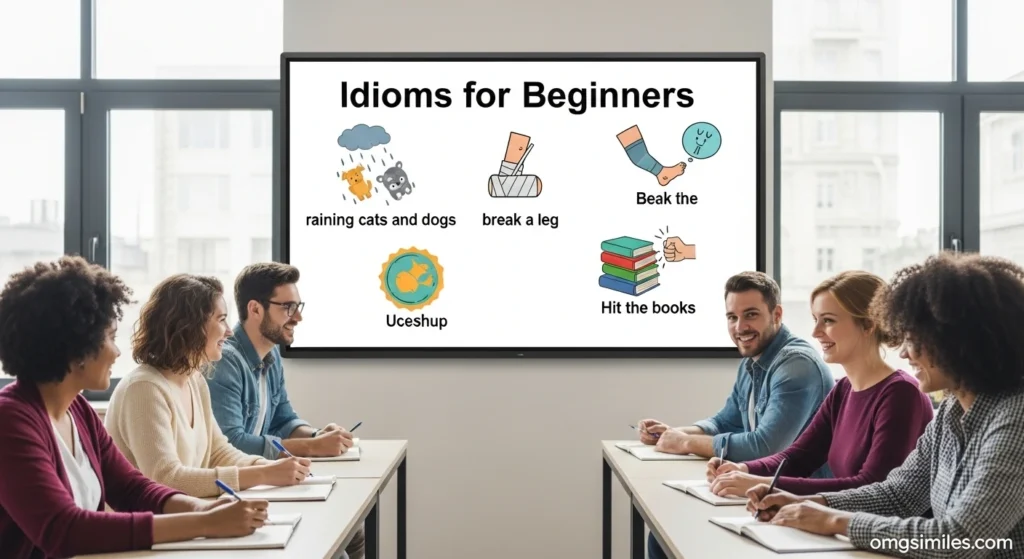
Learning idioms for beginners is one of the most exciting ways to improve your English. Idioms are phrases whose meanings are different from the literal meanings of the words. For example, when someone says “break the ice,” they usually mean starting a conversation or making people feel comfortable—not actually breaking ice.
Idioms are commonly used in figurative language, everyday conversations, movies, books, and social media. They make speech more colorful, natural, and expressive. For English learners, understanding idioms can make communication smoother and help you sound more like a native speaker.
In this beginner-friendly guide, you’ll discover 30 common idioms, their meanings, tone, and practical usage. Each idiom includes simple explanations and example sentences so you can easily use them in real-life situations.
Break the Ice
Meaning: To start a conversation in a social situation where people feel shy or uncomfortable.
Tone: Friendly and social.
Best Usage Context: Meetings, parties, classrooms, or first-time introductions.
Example Sentences:
- The teacher told a funny story to break the ice on the first day of class.
- I asked about his favorite movies to break the ice.
- Playing a game helped everyone break the ice during the workshop.
Quick Texting Example:
- “I’ll tell a joke to break the ice in the meeting ”
Hit the Nail on the Head
Meaning: To describe something exactly right.
Tone: Confident and approving.
Best Usage Context: When someone gives a perfect explanation or solution.
Example Sentences:
- Your idea about improving the website hit the nail on the head.
- She hit the nail on the head when she explained the problem.
- The manager’s comment hit the nail on the head.
Piece of Cake
Meaning: Something very easy to do.
Tone: Casual and positive.
Best Usage Context: When describing easy tasks or activities.
Example Sentences:
- The English test was a piece of cake.
- Cooking pasta is a piece of cake.
- Once you learn the basics, coding becomes a piece of cake.
Daily Use Sentence:
- “Don’t worry about the assignment—it’s a piece of cake.”
Under the Weather
Meaning: Feeling sick or unwell.
Tone: Informal.
Best Usage Context: When talking about minor illness.
Example Sentences:
- I’m feeling under the weather today.
- She skipped school because she was under the weather.
- He looks under the weather this morning.
Once in a Blue Moon
Meaning: Something that happens very rarely.
Tone: Casual.
Best Usage Context: When talking about rare events.
Example Sentences:
- I eat fast food once in a blue moon.
- We travel abroad once in a blue moon.
- He watches TV once in a blue moon.
Spill the Beans
Meaning: To reveal a secret.
Tone: Informal.
Best Usage Context: When someone accidentally or intentionally tells secret information.
Example Sentences:
- Don’t spill the beans about the surprise party.
- She accidentally spilled the beans about the gift.
- Someone spilled the beans, and now everyone knows.
Cost an Arm and a Leg
Meaning: Something very expensive.
Tone: Informal.
Best Usage Context: Talking about expensive products or services.
Example Sentences:
- That smartphone costs an arm and a leg.
- The vacation cost an arm and a leg.
- Designer clothes often cost an arm and a leg.
A Blessing in Disguise

Meaning: Something that seems bad at first but later turns out good.
Tone: Reflective and positive.
Best Usage Context: When talking about unexpected positive outcomes.
Example Sentences:
- Losing that job was a blessing in disguise.
- The delay turned out to be a blessing in disguise.
- Missing the bus was a blessing in disguise.
Let the Cat Out of the Bag
Meaning: To reveal a secret accidentally.
Tone: Playful and informal.
Best Usage Context: When someone spoils a surprise.
Example Sentences:
- He let the cat out of the bag about the party.
- I almost let the cat out of the bag yesterday.
- Don’t let the cat out of the bag yet!
Bite the Bullet
Meaning: To face a difficult situation with courage.
Tone: Serious but encouraging.
Best Usage Context: When someone accepts something unpleasant.
Example Sentences:
- I had to bite the bullet and finish the project.
- She bit the bullet and apologized.
- Sometimes you must bite the bullet and move forward.
Burn the Midnight Oil
Meaning: To work late into the night.
Tone: Motivational.
Best Usage Context: Studying or working hard.
Example Sentences:
- I burned the midnight oil before my exam.
- The team burned the midnight oil to finish the report.
- Writers often burn the midnight oil.
Kill Two Birds with One Stone
Meaning: To achieve two goals with one action.
Tone: Practical.
Best Usage Context: Efficiency and productivity.
Example Sentences:
- Walking to work kills two birds with one stone—exercise and travel.
- Online courses kill two birds with one stone.
- I called him while driving to kill two birds with one stone.
The Ball Is in Your Court
Meaning: It’s your turn to take action.
Tone: Neutral.
Best Usage Context: Decision-making situations.
Example Sentences:
- I’ve done my part; now the ball is in your court.
- The company offered the job—the ball is in your court now.
- I shared my idea; the ball is in your court.
Add Fuel to the Fire
Meaning: To make a situation worse.
Tone: Negative.
Best Usage Context: Conflicts or arguments.
Example Sentences:
- His rude comment added fuel to the fire.
- Don’t add fuel to the fire by arguing more.
- The news report added fuel to the fire.
On Cloud Nine
Meaning: Extremely happy.
Tone: Very positive.
Best Usage Context: Exciting life moments.
Example Sentences:
- She was on cloud nine after getting the job.
- I’m on cloud nine about the good news.
- He felt on cloud nine after winning.
Hit the Sack
Meaning: To go to sleep.
Tone: Casual.
Best Usage Context: Informal conversation.
Example Sentences:
- I’m tired—I’ll hit the sack now.
- She hit the sack early yesterday.
- After the long trip, we all hit the sack quickly.
Pull Someone’s Leg
Meaning: To joke or tease someone.
Tone: Playful.
Best Usage Context: Friendly conversations.
Example Sentences:
- Relax, I’m just pulling your leg.
- They were pulling his leg about his new haircut.
- Are you serious or pulling my leg?
The Best of Both Worlds
Meaning: Enjoying two advantages at the same time.
Tone: Positive.
Best Usage Context: Balanced lifestyles.
Example Sentences:
- Working from home gives me the best of both worlds.
- This job offers the best of both worlds.
- Online learning gives students the best of both worlds.
Cut to the Chase
Meaning: Get to the main point.
Tone: Direct.
Best Usage Context: Business or meetings.
Example Sentences:
- Let’s cut to the chase and discuss the plan.
- Stop explaining everything and cut to the chase.
- He finally cut to the chase during the meeting.
Sit on the Fence
Meaning: To avoid making a decision.
Tone: Neutral or slightly negative.
Best Usage Context: Debates or choices.
Example Sentences:
- Don’t sit on the fence—choose a side.
- He’s still sitting on the fence about the offer.
- She refuses to sit on the fence anymore.
Easy Does It
Meaning: Do something slowly and carefully.
Tone: Calm and encouraging.
Best Usage Context: Physical activities or delicate tasks.
Example Sentences:
- Easy does it while lifting the box.
- The doctor said easy does it after surgery.
- Easy does it while learning driving.
Go the Extra Mile
Meaning: To make additional effort.
Tone: Motivational.
Best Usage Context: Work and customer service.
Example Sentences:
- She always goes the extra mile for customers.
- Teachers often go the extra mile for students.
- If you go the extra mile, success will follow.
Keep an Eye On
Meaning: To watch something carefully.
Tone: Neutral.
Best Usage Context: Responsibility or monitoring.
Example Sentences:
- Please keep an eye on my bag.
- The teacher kept an eye on the students.
- I’ll keep an eye on the progress.
Make a Long Story Short
Meaning: To explain something briefly.
Tone: Conversational.
Best Usage Context: Storytelling.
Example Sentences:
- Make a long story short, we missed the flight.
- To make a long story short, the project succeeded.
- Make a long story short, I moved to a new city.
Speak of the Devil
Meaning: The person you were talking about appears.
Tone: Light and humorous.
Best Usage Context: Unexpected appearances.
Example Sentences:
- Speak of the devil, here comes Sarah.
- We were discussing him, and speak of the devil, he called.
- Speak of the devil, there he is!
Through Thick and Thin
Meaning: Supporting someone in good and bad times.
Tone: Emotional and loyal.
Best Usage Context: Friendships or relationships.
Example Sentences:
- True friends stay through thick and thin.
- My family supports me through thick and thin.
- They remained loyal through thick and thin.
Jump on the Bandwagon
Meaning: To follow a popular trend.
Tone: Neutral.
Best Usage Context: Trends, marketing, or social media.
Example Sentences:
- Many brands jumped on the bandwagon of online marketing.
- Everyone jumped on the bandwagon after the trend went viral.
- Don’t jump on the bandwagon blindly.
In Hot Water
Meaning: In trouble.
Tone: Negative.
Best Usage Context: Mistakes or problems.
Example Sentences:
- He got in hot water with his boss.
- I’ll be in hot water if I miss the deadline.
- She landed in hot water after the mistake.
A Piece of the Pie
Meaning: A share of success or profit.
Tone: Business-related.
Best Usage Context: Business, finance, or opportunities.
Example Sentences:
- Everyone wants a piece of the pie in the tech industry.
- Investors hope to get a piece of the pie.
- He asked for a piece of the pie.
Back to the Drawing Board
Meaning: To start again after failure.
Tone: Determined.
Best Usage Context: Projects and planning.
Example Sentences:
- The plan failed, so it’s back to the drawing board.
- We went back to the drawing board after the test results.
- Designers often go back to the drawing board.
Everyday Texting Examples Using Idioms
People often use idioms in messages, chats, and social media. Here are some quick examples:
- “Exam was a piece of cake 😎”
- “I’m on cloud nine after the results!”
- “Let’s cut to the chase—what’s the plan?”
- “Feeling under the weather today 🤒”
- “Don’t spill the beans about the surprise!”
Using idioms like this makes your messages sound natural and engaging.
Tips for Learning Idioms Easily
If you’re just starting with idioms for beginners, these strategies help:
Practice Daily
- Learn 2–3 idioms every day.
Watch Movies and Shows
- Native speakers use idioms frequently.
Write Your Own Sentences
- This helps remember meanings faster.
Use Idioms in Conversation
- Practice with friends or classmates.
Conclusion
Learning idioms for beginners is a powerful way to make your English more natural, expressive, and confident. These colorful phrases help you understand conversations, movies, books, and everyday speech more easily.
At first, idioms may seem confusing because their meanings are not literal. But with practice, they become fun tools that make communication lively and creative.
Start using a few idioms every day—whether in conversation, texting, or writing. Over time, you’ll discover that idioms are not just language tools; they’re also a gateway to understanding culture, humor, and human expression in English.
FAQs
What are idioms in English?
Idioms are phrases whose meanings are different from the literal meanings of their individual words. For example, “piece of cake” means something easy.
Why are idioms important for beginners?
Idioms help learners understand natural English conversations and improve fluency.
How can beginners learn idioms easily?
Beginners can learn idioms by reading examples, watching movies, practicing conversations, and using them in daily sentences.
How many idioms should beginners learn daily?
Learning 2–5 idioms per day is a good pace for most learners.
Are idioms used in formal writing?
Some idioms can be used in informal writing and conversations, but they are less common in formal academic writing.
Do native speakers use idioms often?
Yes. Native speakers frequently use idioms in everyday conversations, movies, and social media.
What is the difference between idioms and phrases?
A phrase is a group of words with literal meaning, while an idiom has a figurative meaning that cannot be understood directly from the words.