
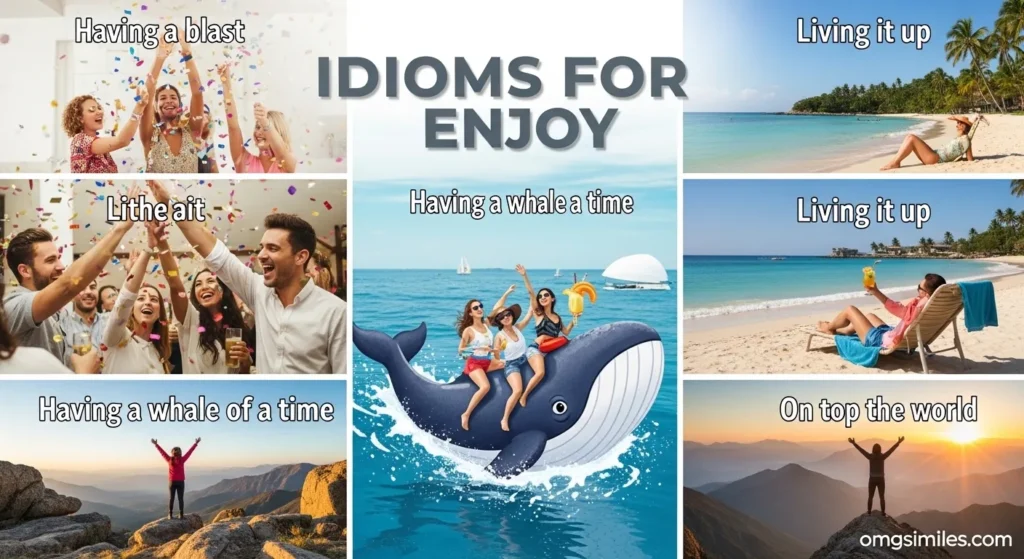
Learning idioms for enjoy is one of the fastest ways to sound more fluent and confident in English. Whether you’re a student writing essays, a professional speaking in meetings, or an English learner improving conversation skills, idioms help you express happiness and pleasure more naturally. They add emotion, color, and personality to your language. In real life, knowing these expressions can help you connect better with others, understand movies and books, and communicate feelings more effectively.
In this comprehensive guide, you’ll discover 15 commonly used idioms for enjoy, complete with meanings, examples, alternative phrases, origins, and real-life use cases. You’ll also find exercises, quizzes, tips, and common mistakes to avoid.
1. Have a Ball
Meaning: To have a great time; to enjoy yourself a lot.
Example: We had a ball at the wedding party last night.
Alternative Expressions: Have a blast, have loads of fun.
Fun Fact/Origin: “Ball” originally referred to a formal dance event where people dressed up and celebrated.
Use Cases: Parties, festivals, vacations, birthdays.
2. Have the Time of Your Life
Meaning: To experience the most enjoyable time ever.
Example: She had the time of her life traveling through Europe.
Alternatives: Best time ever, unforgettable experience.
Typical Scenarios: Travel stories, graduation celebrations, concerts.
3. On Cloud Nine
Meaning: Extremely happy or delighted.
Example: He was on cloud nine after getting the promotion.
Alternative Expressions: Over the moon, thrilled to bits.
Origin: Possibly linked to meteorology, where cloud nine was considered the highest cloud. Use Cases: Success, achievements, surprises.
4. Over the Moon
Meaning: Very pleased or happy.
Example: She was over the moon about her exam results.
Alternatives: Delighted, ecstatic.
Common Context: Personal achievements, good news.
5. In Seventh Heaven

Meaning: In a state of extreme happiness.
Example: He was in seventh heaven when he met his favorite actor.
Origin: Comes from ancient beliefs about seven levels of heaven.
Use Cases: Dreams coming true, romantic moments.
6. Live It Up
Meaning: To enjoy life in an energetic and exciting way.
Example: They’re living it up on their beach vacation.
Alternative Expressions: Party hard, celebrate wildly.
Typical Scenarios: Holidays, bachelor parties, trips.
7. Paint the Town Red
Meaning: Go out and celebrate enthusiastically.
Example: Let’s paint the town red after exams!
Origin: 19th-century England; possibly linked to wild celebrations.
Use Cases: Night out with friends.
8. Enjoy to the Fullest
Meaning: Experience something completely and without holding back.
Example: She enjoyed her college years to the fullest.
Alternative: Make the most of it.
Typical Scenario: Motivational talks, advice.
9. Have a Blast
Meaning: Have a very enjoyable time.
Example: The kids had a blast at the amusement park.
Alternative: Have tons of fun.
Use Cases: Informal conversations.
10. Be in Your Element
Meaning: Feel happy and comfortable in a situation.
Example: She’s in her element when teaching.
Origin: From the idea of natural elements (earth, water, fire, air).
Use Cases: Work, hobbies, talents.
11. Have a Whale of a Time
Meaning: Have a very fun and exciting time.
Example: We had a whale of a time at the carnival.
Fun Fact: “Whale” here means something large or impressive.
Use Cases: Family events, fairs.
12. Eat, Drink, and Be Merry
Meaning: Enjoy life’s pleasures.
Example: During holidays, people eat, drink, and are merry.
Origin: From the Bible (Ecclesiastes).
Use Cases: Festivals, weddings.
13. Take Pleasure In
Meaning: To enjoy something deeply. Example: She takes pleasure in reading poetry. Alternative: Delight in. Use Cases: Formal writing, essays.
14. Relish the Moment
Meaning: To fully enjoy a present experience. Example: Relish the moment—you’ll remember it forever. Alternative: Savor the moment. Use Cases: Motivational advice.
15. Kick Back and Relax
Meaning: To enjoy yourself in a relaxed way. Example: On Sundays, I kick back and relax. Alternative: Chill out. Use Cases: Casual conversations.
Grouping Idioms by Context
🎉 For Parties & Celebrations
- Have a ball
- Paint the town red
- Have a blast
🌟 For Achievements & Good News
- On cloud nine
- Over the moon
- In seventh heaven
🌿 For Calm & Relaxation
- Kick back and relax
- Relish the moment
Interactive Practice Section
Exercise 1: Fill in the Blanks (Easy)
- After winning the match, he was ______ cloud nine.
- Let’s ______ the town red tonight.
- She had a ______ of a time at the festival.
Answers:
- on
- paint
- whale
Exercise 2: Match the Idiom (Medium)
Match the idiom with its meaning:
A. Live it up B. Be in your element C. Have the time of your life
- Feel comfortable and happy
- Enjoy something exciting
- Experience the best time ever
Answers: A-2 B-1 C-3
Exercise 3: Advanced Challenge
Rewrite the sentence using an idiom for enjoy:
- I enjoyed the concert very much.
- She felt extremely happy about her new job.
Sample Answers:
- I had a blast at the concert.
- She was over the moon about her new job.
Common Mistakes to Avoid
- ❌ Saying “I am enjoy” instead of “I enjoy” or “I am enjoying.”
- ❌ Mixing idioms incorrectly (e.g., “on the moon nine”).
- ❌ Using very informal idioms in formal essays.
Tips for Using Idioms Effectively
- Learn idioms in context, not isolation.
- Practice in conversations or journaling.
- Watch English movies and note how native speakers use them.
- Don’t overuse idioms in formal writing.
Visual & Infographic Suggestions
For better retention, create:
- A mind map grouping idioms by emotion.
- Flashcards with idioms on one side and meaning on the other.
- A comparison chart showing formal vs. informal idioms for enjoy.
Extra Value: Why Idioms Improve Fluency
Using idioms for enjoy helps you:
- Sound natural and fluent
- Understand movies and books
- Improve writing style
- Express emotions vividly
- Build stronger social connections
Professionals can use these idioms in presentations or team conversations to sound engaging. Students can enhance essays and speeches. English learners can feel more confident speaking with native speakers.